


Find Your Putting Rhythm: The Hidden Skill Most Golfers Never Train
- JB Coaching

- Nov 20, 2025
- 3 min read
Every golfer has a natural rhythm. You hear it in their full swing, you see it in their pre-shot routine, and you feel it in the way they move. Yet when it comes to putting, rhythm is the one element most golfers never think about.
And it’s a huge reason why pace control breaks down.
In my studio, rhythm is one of the first things I look for. Not how “pretty” the stroke looks, but how smoothly the putter accelerates, how the hands behave, and whether the golfer can produce the same tempo from 6 feet as they do from 30 feet. When you learn to control this, your distance control becomes far more predictable — and your 3-putts start to disappear.
Why Rhythm Matters More Than You Think
Most golfers try to guide the putt with their hands. They hit at the ball, decelerate, or panic-accelerate as they approach impact. All of these create inconsistent strike quality and unpredictable ball speed.
A good rhythm allows you to:
Control the putter head without tension
Produce a clean, centred strike
Maintain a consistent tempo across all distances
Match stroke length to the intended pace of the putt
When the putter is flowing with you instead of being forced by your hands, everything becomes easier.
Signs Your Rhythm Is Off:
If any of these sound familiar, your rhythm needs work:
A sudden “hit” at the ball
A long backswing but a rushed downswing
A short backswing with a big shove through impact
Excessive hand action
Struggling to control long putts
Putts finishing miles past or short despite a good read
Many golfers have the mechanics to hit great putts — but their timing ruins everything.
A Real Example From the Studio
Below are two real Capto graphs showing Target Hands Acceleration — a powerful way of understanding a golfer’s rhythm and how they deliver energy to the ball.
Image 1 - “Target Hands Acceleration – Poor Rhythm”

This first graph shows:
Shape Quality: 0.53
A clear spike in hand acceleration approaching impact
A forced, hand-driven motion
Inconsistent tempo between backswing and downswing
This is the typical pattern for golfers who “hit” at the ball.
Even if the technique looks fine, the timing breaks down — resulting in poor distance control.
Image 2 - “Target Hands Acceleration – Improved Rhythm”
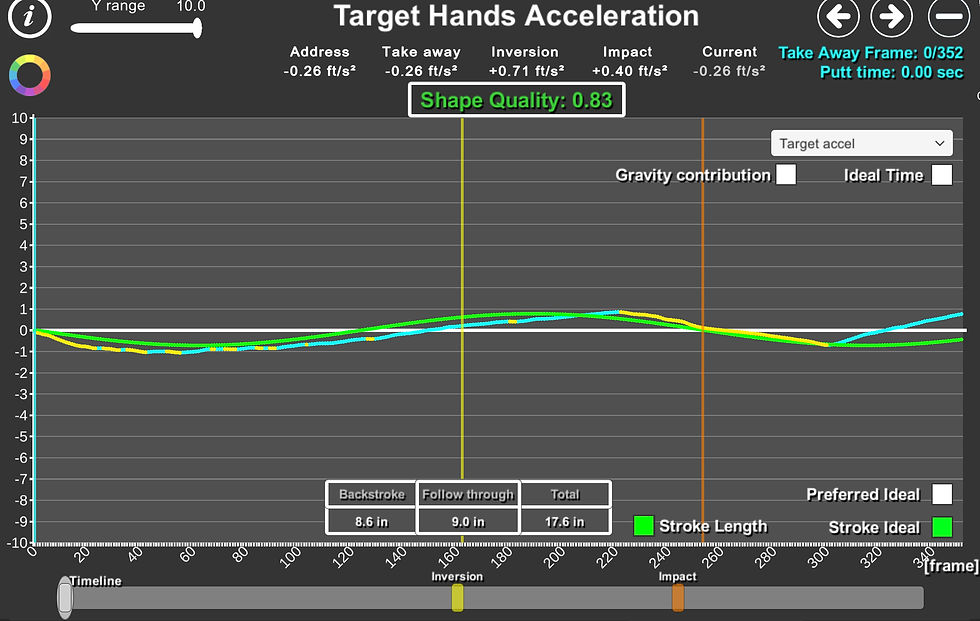
The second graph shows:
Shape Quality improving to 0.83
A smoother, more even acceleration curve
A natural “flow” through the ball
Better balance between stroke length back and through
This represents the rhythm used by elite putters — controlled, unforced and consistent.
How Elite Players Train Rhythm
With the county players and competitive amateurs I coach, rhythm is always trained deliberately.
Here’s how we build it:
1. Reduce Excess Hand Speed
If your hands are doing the work, you’ve already lost control.
This is why changes like left-hand-low or claw often free up the stroke.
2. Let Gravity Help You
A smooth backstroke followed by a natural, unforced release creates effortless distance control.
A simple cue I give players:
“Let the putter head fall, don’t pull it.”
3. Balance the Stroke Length
Elite putters move the putter with a much more balanced motion — closer to 50/50 — instead of a tiny backswing and a big shove.
4. Use Constraints to Train Feel
Metronome tempo work
No-hand drills
Gate drills
Stroke-length ladders
These build the timing and flow that great putters rely on.
A Simple Drill You Can Try Today
The “Back–Flow–Forward” Drill
Set up normally.
Create a smooth, slightly quicker backstroke than you think.
Allow the putter to fall into the ball.
Rotate your body to deliver the strike — not your hands.
The feeling is effortless and instantly more repeatable.
The Bottom Line
Great putting isn’t just about mechanics — it’s about rhythm.
When your hands stop overpowering the stroke and the putter moves in harmony with your body, every part of your putting improves:
start line, strike quality, pace control, and confidence.
If you want to discover your natural rhythm and learn to control it on the greens, book a session in the JB Coaching Putting Studio.
It’s one of the most powerful improvements you can make — and the results are immediate.


Comments